Say it out loud.
Read a word, sentence, or passage. Hear the coach, then record your own take.
Your voice is the starting point.
Your American English pronunciation coach
You have something to say. Make it clear with practice built around your voice, from single sounds to the talk you’re giving next week.
Coming soon to iOS & Android
A little practice. A clearer voice.
Read a word, sentence, or passage. Hear the coach, then record your own take.
Your voice is the starting point.
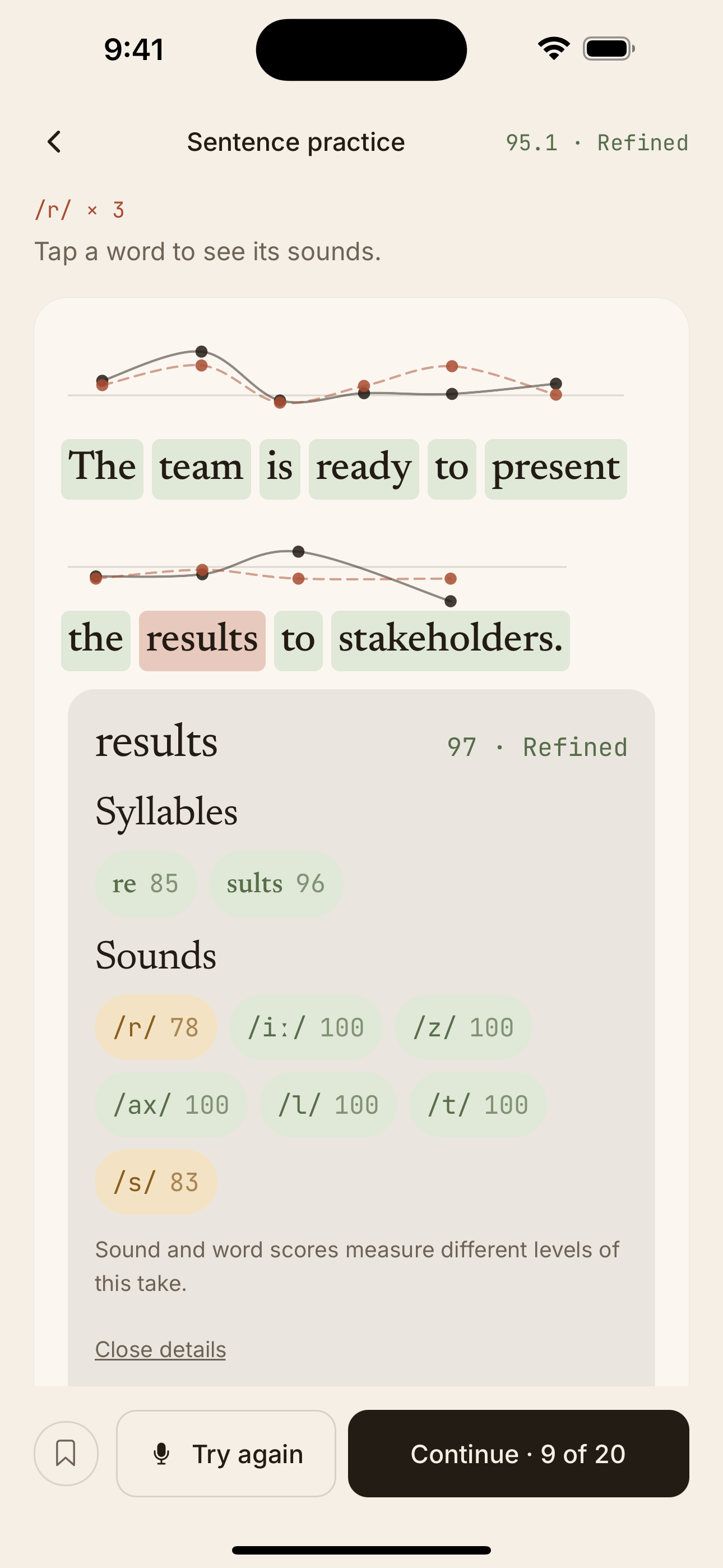
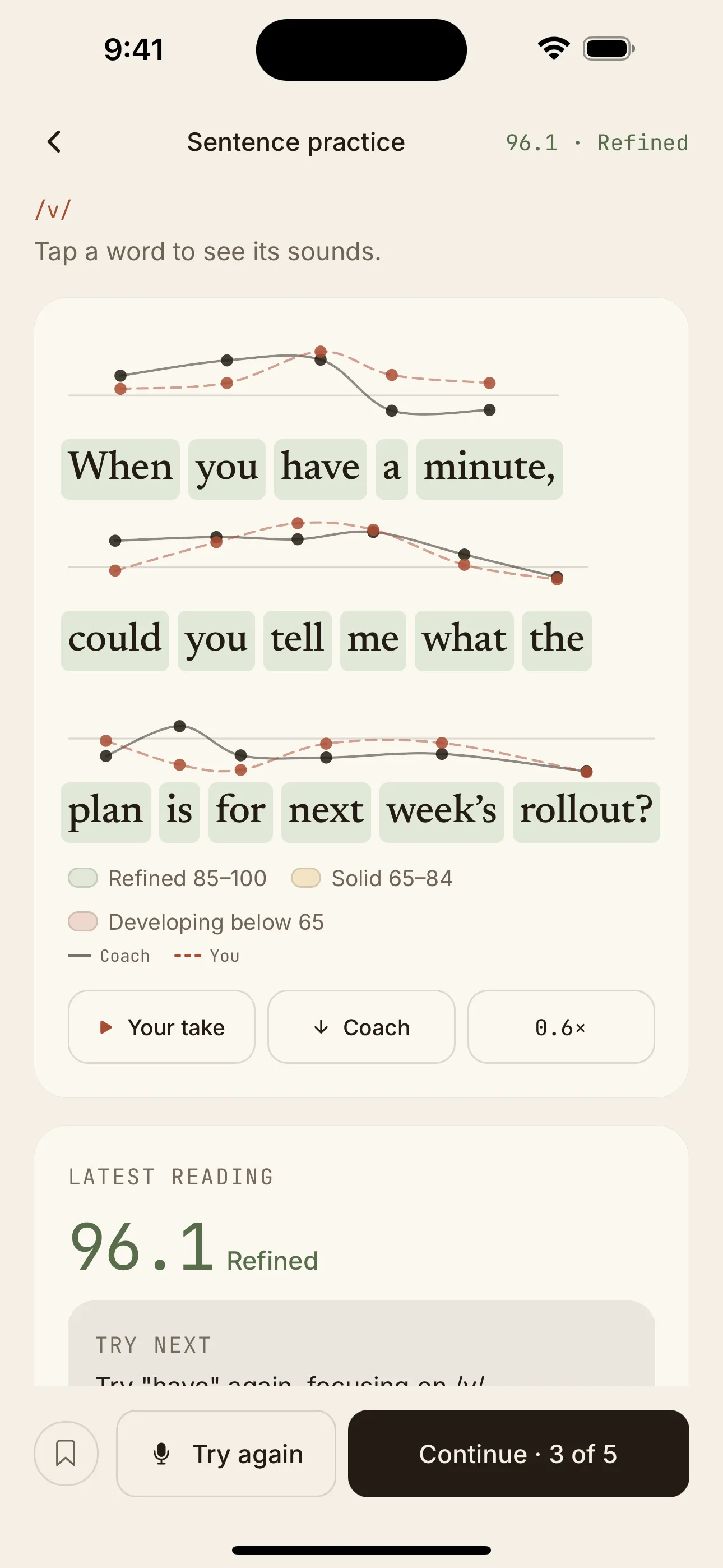
Find the sounds to work on and see how your sentence melody compares with the coach’s.
Feedback you can put into practice.
Follow mouth-position guidance and focused drills. Watch your sound history develop with each take.
A plan that grows with you.
My scripts · Your own text
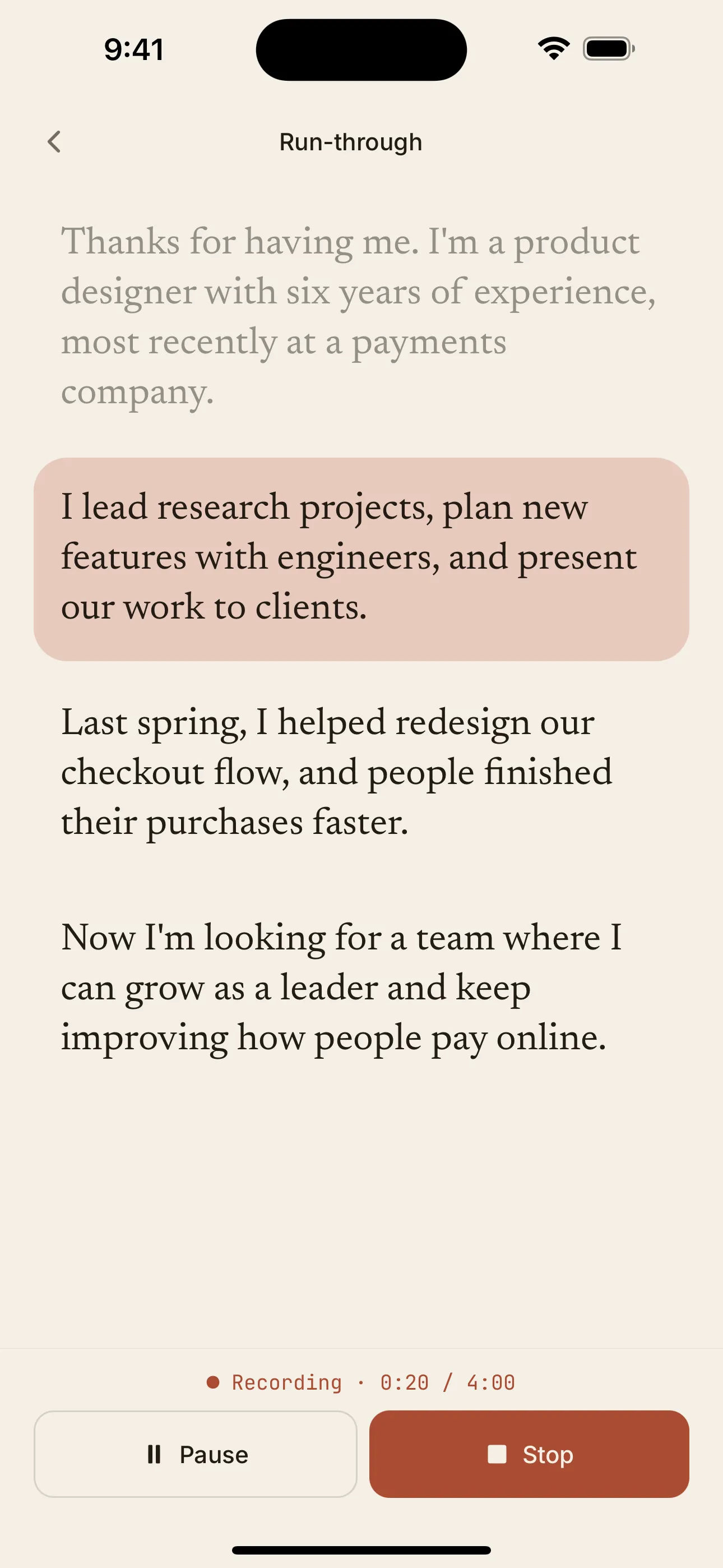
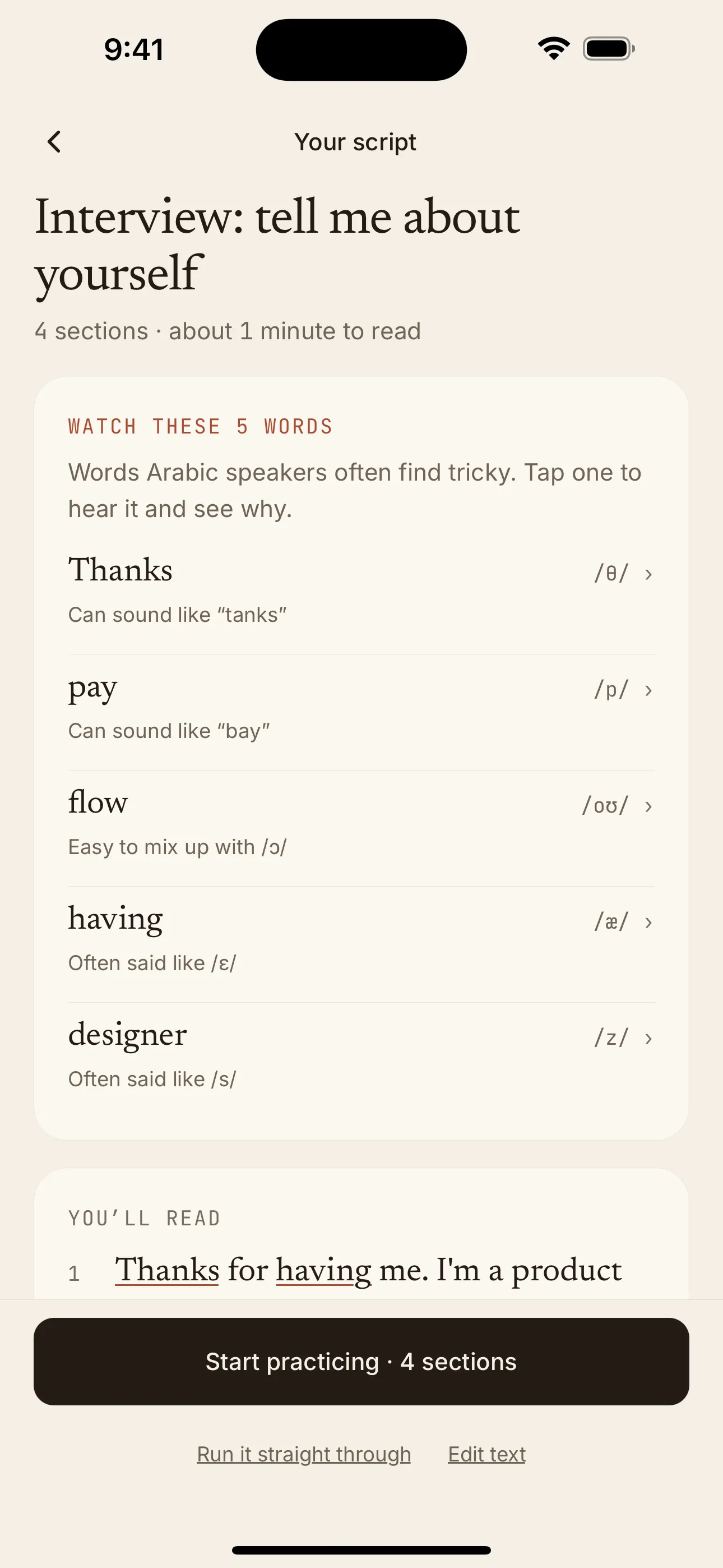
Paste an interview answer, the start of a talk, or your Monday update. Ekavo turns it into short sections with coach audio, so you rehearse what matters this week.
Before your first take, see the words in your text that speakers of your first language often find tricky, and what to listen for.
Hear the coach read each part, record your own, and get the same sound-by-sound feedback as every other exercise.
When it feels steady, read the whole thing the way you will on the day. Add the date, and Ekavo suggests what to practice as it gets closer.
A closer look
A score is only a starting point.
Ekavo helps you understand what to try next.
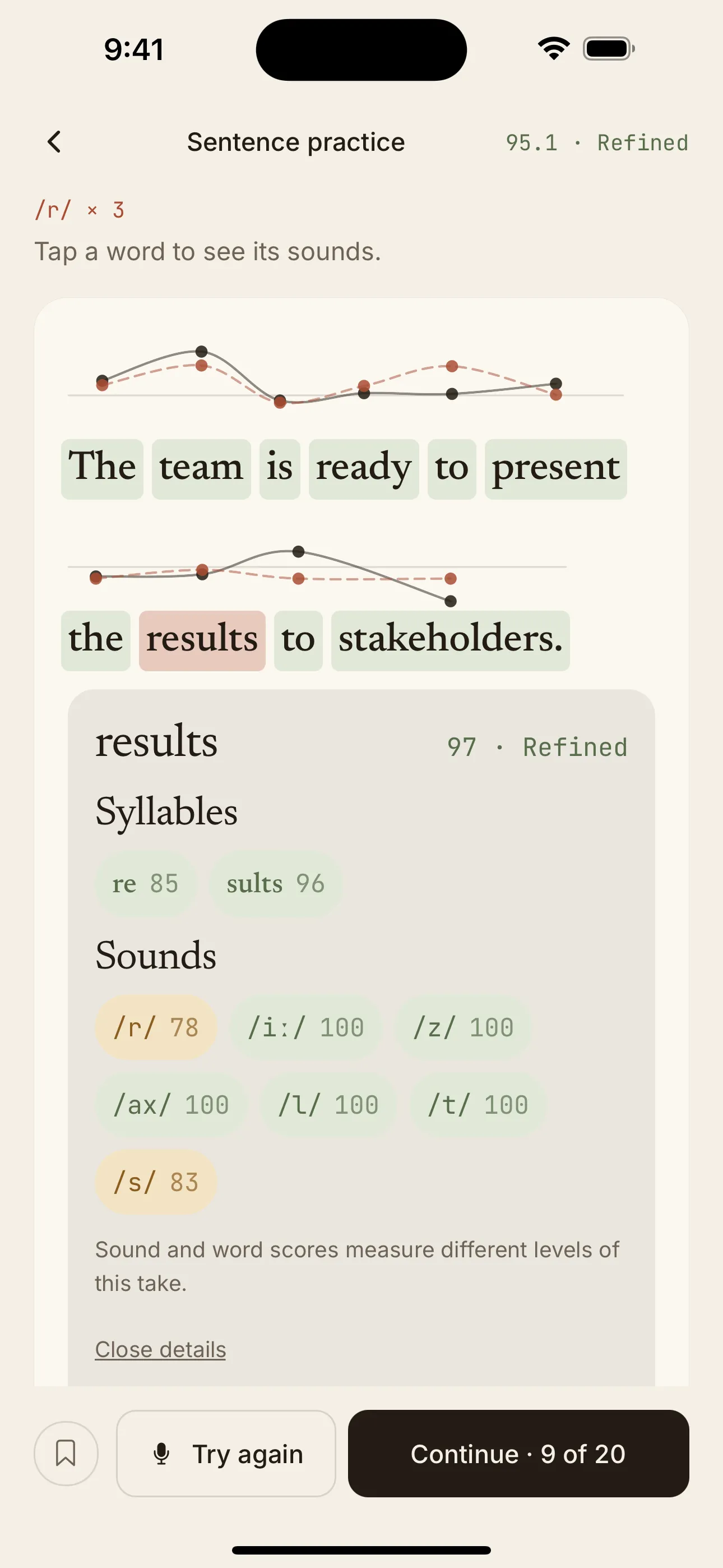
01 Sound by sound
Look inside a word to see which sounds need attention. One take can show that a single sound is holding a word back.
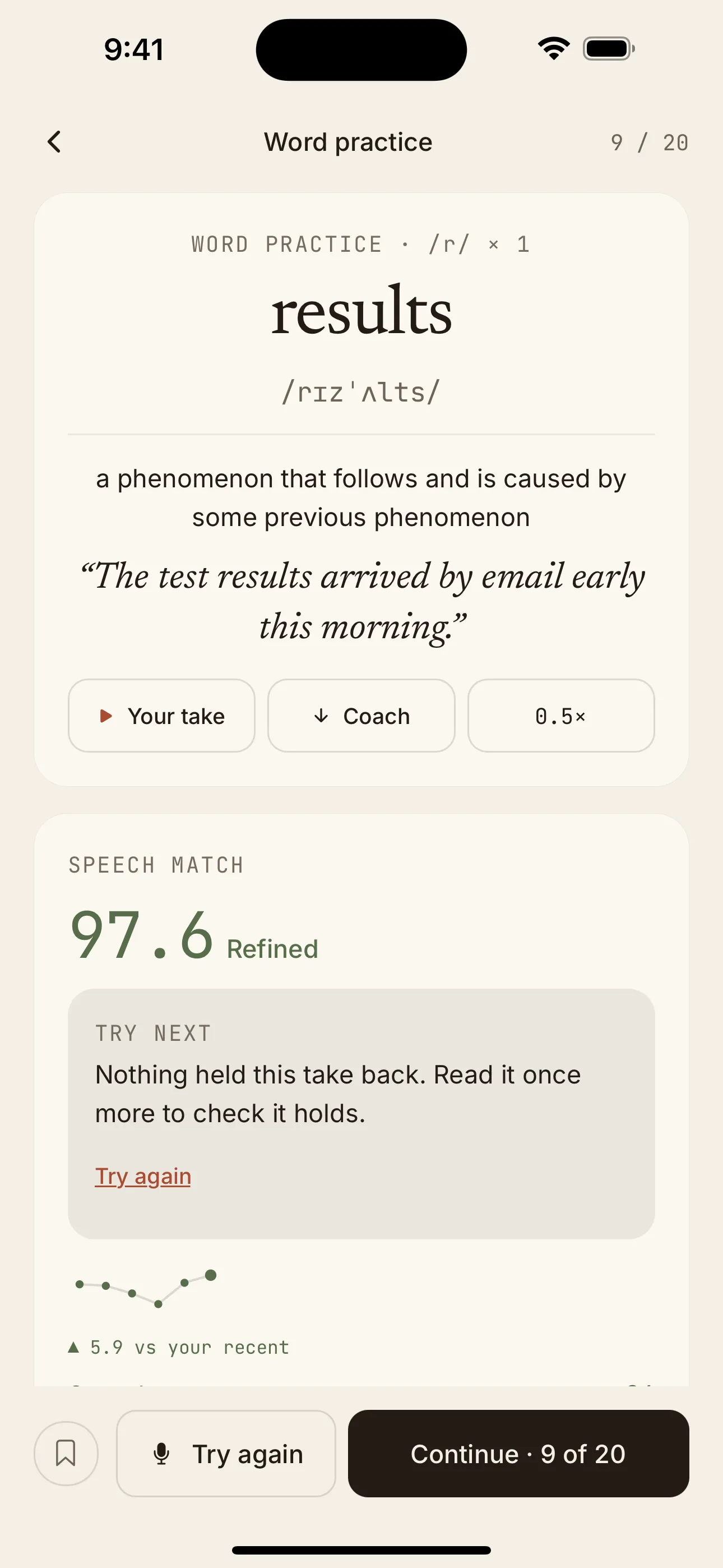
02 Focused practice
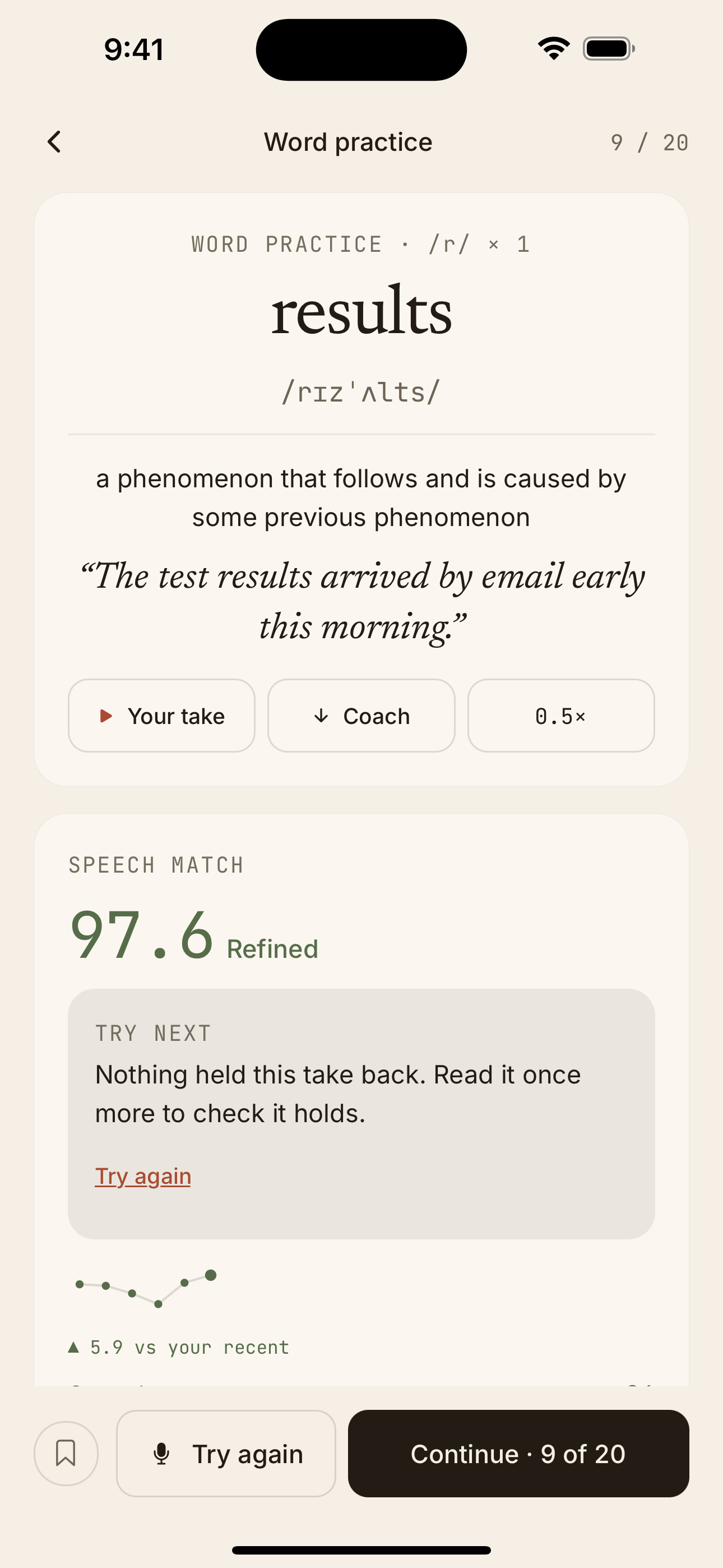
Take a word into its own drill. Each take is scored against your recent ones, so you can see when a change starts to hold.
03 Practice in conversation
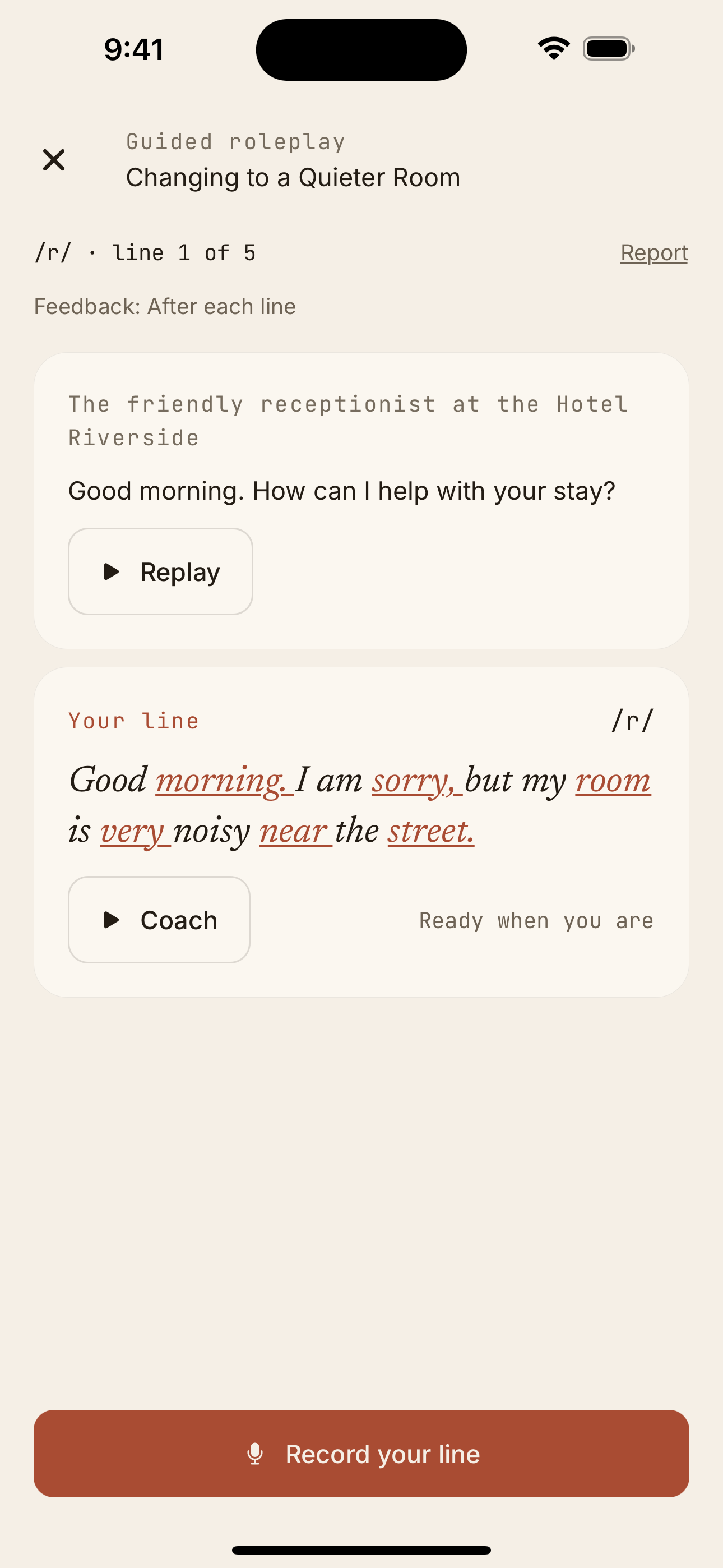
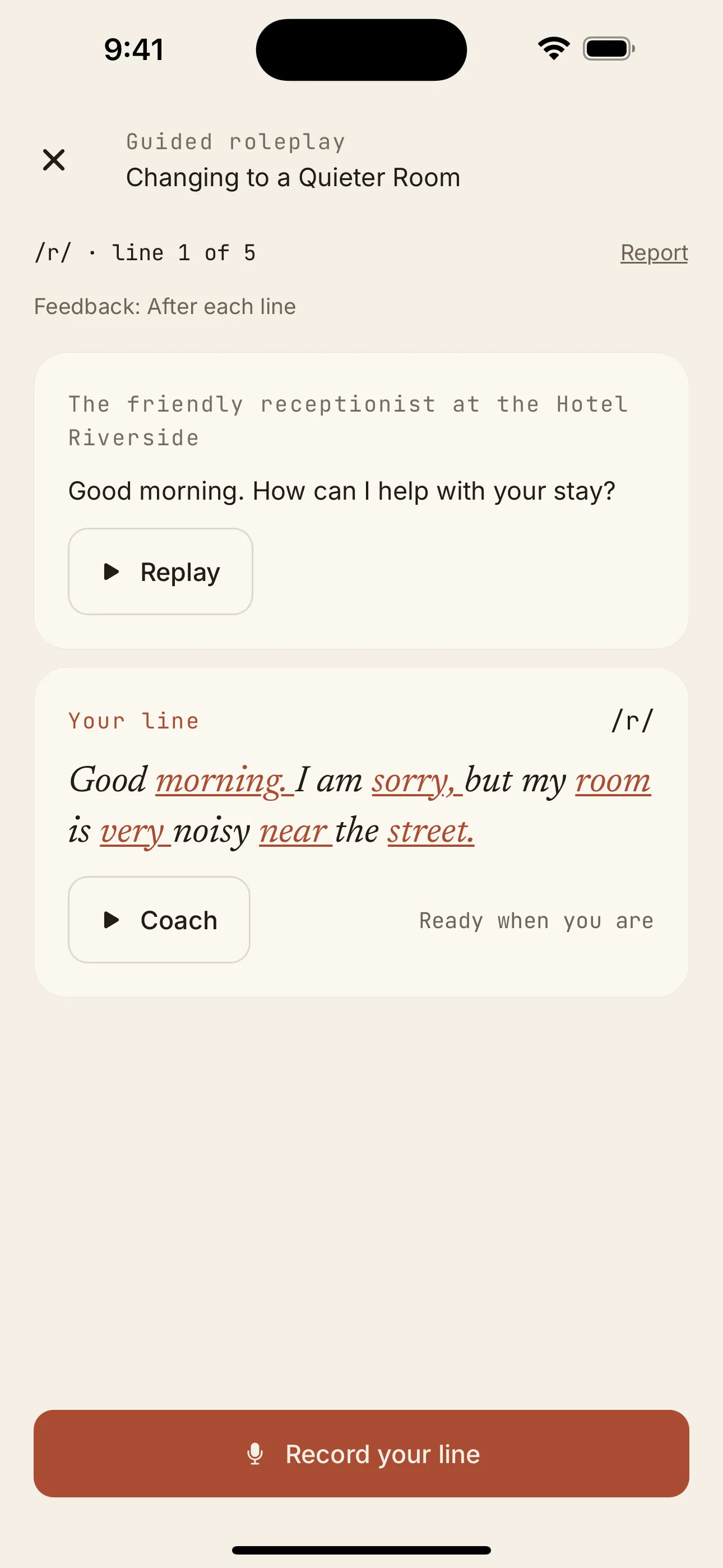
Step into short everyday conversations. The other person speaks, you say your line, and you get feedback on the sound you’re working on.
Built around your beginnings
The English sounds you find familiar, and the ones that take practice, have a history. Ekavo uses your first language as a starting point, then learns from your speech.
A starting point, never a label. Your own recordings shape your plan.
One possible practice focus /p/ · /b/
parkbark
Explore how voicing separates the English P and B sounds.
Explore pronunciation guidesOne possible practice focus /v/ · /b/
veryberry
Explore keeping air flowing between your top teeth and lower lip for V, then closing both lips for B.
Explore pronunciation guidesOne possible practice focus /r/ · /l/
rightlight
Explore two distinct tongue positions for the English R and L sounds.
Explore pronunciation guidesOne possible practice focus /d/ · /t/
bedbet
Explore final D and T, listening for the longer vowel in bed compared with bet.
Explore pronunciation guidesOne possible practice focus /z/ · /s/
zipsip
Explore the buzz of voicing that separates Z from S.
Explore pronunciation guidesOne possible practice focus /ɪ/ · /i/
shipsheep
Explore the short, relaxed vowel in ship and how it differs from the vowel in sheep.
Explore pronunciation guidesOne possible practice focus /w/ · /v/
winevine
Explore rounding your lips for W without letting your top teeth touch your lower lip.
Explore pronunciation guidesOne possible practice focus /tʃ/ · /ʃ/
chipship
Explore the brief tongue stop at the start of CH, which SH does not have.
Explore pronunciation guidesOne possible practice focus /θ/ · /t/
thanktank
Explore the tongue position and steady airflow of the English TH sound.
Explore pronunciation guidesOne possible practice focus /v/ · /w/
vinewine
Explore the difference between V and W, with focused practice for each sound.
Guides for Hindi speakersOne possible practice focus /θ/ · /t/
thintin
Explore letting air pass over your tongue for TH instead of stopping it for T.
Explore pronunciation guidesOne possible practice focus /æ/ · /ɛ/
batbet
Explore opening your jaw wider for the vowel in bat than for the vowel in bet.
Explore pronunciation guidesOne possible practice focus /l/ · /r/
lightright
Explore two distinct tongue positions for the English L and R sounds.
Explore pronunciation guidesOne possible practice focus /ð/ · /d/
thenden
Explore a voiced TH with your tongue lightly between your teeth, compared with D.
Explore pronunciation guidesOne possible practice focus /f/ · /p/
fanpan
Explore steady airflow for F and the brief release of air for P.
Explore pronunciation guidesOne possible practice focus /ʃ/ · /s/
shesee
Explore the rounded lips and farther-back tongue of SH, compared with S.
Explore pronunciation guidesOne possible practice focus /z/ · /s/
buzzbus
Explore final Z and S, listening for voicing and the longer vowel in buzz compared with bus.
Explore pronunciation guidesOne possible practice focus /θ/ · /s/
thinksink
Explore the difference between TH and S, starting with tongue placement.
Guides for Mandarin speakersOne possible practice focus /ð/ · /d/
theyday
Explore letting air pass over your tongue for the TH in they instead of stopping it for D.
Explore pronunciation guidesOne possible practice focus /ʊ/ · /u/
pullpool
Explore the short, relaxed vowel in pull and how it differs from the vowel in pool.
Explore pronunciation guidesOne possible practice focus /w/ · /v/
westvest
Explore starting W with rounded lips that never touch your teeth.
Explore pronunciation guidesOne possible practice focus /θ/ · /f/
threefree
Explore placing your tongue lightly between your teeth for TH instead of using your lower lip.
Explore pronunciation guidesOne possible practice focus /l/
feelfinal L
Explore keeping your tongue in contact behind your upper teeth at the end of a word.
Explore pronunciation guidesOne possible practice focus /s/ + consonant
speakS clusters
Explore starting words like speak and school directly on the S, without a vowel before it.
Explore pronunciation guidesOne possible practice focus /ð/ · /z/
thenZen
Explore moving your tongue forward to your teeth for TH, compared with the buzz of Z.
Explore pronunciation guidesOne possible practice focus /b/ · /v/
berryvery
Explore the difference between B and V, with attention to your lips and teeth.
Guides for Spanish speakersOne possible practice focus /dʒ/ · /j/
jetyet
Explore starting J with a brief tongue stop, so jet stays different from yet.
Explore pronunciation guidesOne possible practice focus /f/ · /p/
fastpast
Explore steady airflow between your top teeth and lower lip for F, compared with closed lips for P.
Explore pronunciation guidesOne possible practice focus /θ/ · /t/
threetree
Explore the tongue position and airflow of the English TH sound.
Explore pronunciation guidesOne possible practice focus /z/ · /s/
zooSue
Explore turning your voice on at the start of Z, so zoo stays different from Sue.
Explore pronunciation guidesOne possible practice focus /w/ · /v/
wetvet
Explore the difference between W and V, starting with your lips.
Explore pronunciation guidesOne possible practice focus /w/ · /v/
worseverse
Explore rounding your lips for W, then touching your top teeth to your lower lip for V.
Explore pronunciation guidesOne possible practice focus /θ/ · /t/
thintin
Explore steady airflow over your tongue for TH, compared with the brief stop for T.
Explore pronunciation guidesOne possible practice focus Final consonants
wordendings
Explore the sounds at the ends of words, with focused listening and speaking practice.
Explore pronunciation guidesNo, and we wouldn't want it to. Ekavo works on being understood: the specific sounds and sentence melody that cause listeners to mishear you. Everything else about how you speak is yours.
Adults who already use English and want to be understood more easily: at work, in interviews, in class, or day to day. Ekavo coaches American English and starts from your first language, with a tailored starting point for 34 of them. If yours isn't one yet, practice personalizes from your recordings.
If you can read and follow English but rarely speak it, yes. Choose the Beginner level when you start, and you'll get guided conversations written for that level. Ekavo doesn't teach English from scratch: every exercise asks you to read a line aloud.
Yes. With My scripts, you paste what you plan to say, like an interview answer or the start of a talk, up to 1,500 characters. Before your first take, Ekavo lists the words to watch for your first language. Then you practice section by section with coach audio, and read it straight through when you're ready.
It starts from your first language, so practice begins with the sounds most likely to matter for you, then follows your own recordings. Feedback goes down to individual sounds, with mouth diagrams that show how to make each one, and sentence melody, so you hear the rhythm and not just the words.
Each recording is sent securely to be scored, then discarded. We keep your scores, not your voice, and we never use your audio to train AI models. The app keeps a temporary copy on your phone so you can replay your take; it is deleted when you record again or leave the screen. You can delete your account and your practice data from inside the app.
iOS and Android, launching soon. Scoring needs a connection; the sound library and diagrams work offline.
Keep what makes you, you.
Your accent is part of your story. Ekavo helps you practice the sounds and rhythms that make you easier to understand, while keeping your voice your own.
Coming soon to iOS & Android